Thursday, March 7, 2013

Video Game Review: 'Shadow of the Colossus'


Film critic Roger Ebert published an entry on his online Chicago Sun-Times journal back on April 16, 2010, titled “Video games can never be art.”

The legendary critic made a lot of enemies in the video game world that day, an outcome he probably anticipated. Now, I’ve never put much stock into his comments, simply because art is such a subjective form of expression. Even Ebert posits that his opinions shouldn’t upset the gaming public, as they are just that: opinions.

“Do they require validation? In defending their gaming against parents, spouses, children, partners, co-workers or other critics, do they want to be able to look up from the screen and explain, ‘I'm studying a great form of art?’ Then let them say it, if it makes them happy,” Ebert writes.

Still, it’s a fun debate to further, and I’d like to add my own entry into the fray: Team ICO’s 2005 Playstation 2 masterpiece, “Shadow of the Colossus.”

I received “The ICO and Shadow of the Colossus Collection” as a birthday gift from my brother a couple of years ago, but only got around to playing it rather recently. I had originally intended to tackle “ICO” first, but “Shadow” proved far too intriguing to wait for.

“Shadow of the Colossus” follows Wander, a young man who travels with his trusty horse, Agro, to the Forbidden Land in order to resurrect a maiden named Mono, presumably his lover. A disembodied voice tells Wander that this can only be accomplished if the hero defeats the 16 colossi that inhabit the Forbidden Land. The voice also warns that a great price may be involved in the resurrection.

Taking control of Wander, the player proceeds to defeat, one by one, each unique colossus. Some are humanoid in nature while others resemble creatures, and all possess distinctly different weaknesses that the player must discern and exploit.

More than any game I have played in recent memory, “Shadow” feels like a retro game in a newer game’s clothing. Aside from a very rudimentary tutorial given just before encountering the first colossus, the game’s controls are left to the player to figure out. The game’s instruction manual provides more insights into the initial story than the actual game does, much like the many NES games of yore.

It proved surprisingly refreshing to be dropped into a world like this one, with very little direction or handholding. Admittedly, in most other games, I’d list this as a fault, but the way “Shadow” comes together as a complete package justifies the lack of direction.

While the Forbidden Land is certainly one of the most beautiful ever conceived for a video game, it is uninhabited by humans. Wander is the only living person in it, and his only companion is Agro. The lack of any extensive tutorial serves to further the feeling of loneliness and, consequently, companionship with Wander’s steed.

The Forbidden Land is a quietly beautiful place, with the ruins and remnants of a civilization long gone peppered throughout the landscape. Small creatures also inhabit the land, including lizards, fish, birds and more.

The only enemies Wander faces, however, are the 16 hulking colossi. Traveling from the Shrine of Worship to each subsequent colossus fight is fun, and allows the player to absorb the wonder and majesty of the forgotten land. But the crux of the game, as its name suggests, is battling the colossi.

Though it took me one or two fights to finally get the hang of the game’s controls, “Shadow”’s battles are simply exhilarating. Each colossus is unique, and most require a great deal of trial and error to figure out just how to go about bringing them down. Frustration sets in rather often, at least it did for me, but the feeling accomplishment that comes along with finally killing each colossus far outweighs the desire to throw the controller. The sense of scale in these battles is unprecedented, and the fact that the HD remaster’s framerate remains mostly constant is very impressive, even on the powerful PS3.

The game’s controls are far from perfect, however. The control scheme employed by “Shadow” is perhaps its biggest misstep. It would be easy to blame the game’s age, but 2005 was not all that long ago. Other games of this type have employed better control schemes, and “Shadow” would’ve done well to look at their influence when crafting its controls.

That said, most players tend to have a moment in which the controls and the game mechanics just “click.” For me, that moment came sometime during the third colossus battle. From then on, the controls didn’t give me many problems, though I had a few frustrating moments here and there during the remainder of the game.

One problem that is never quite remedied is that of the camera. The right thumb stick controls the camera, but for some strange, inexplicable reason, it bounces right back when the thumb stick is released.

Visually and aurally, “Shadow” is a masterpiece, through and through. The visuals appear a little dated today, even on the “ICO and Shadow of the Colossus” HD remaster I played, but that can’t diminish their beauty, power and minimalist simplicity.

Composer Kow Otani composed and arranged the game’s entire score, and it still stands as a monumental triumph in video game music. The score only plays during cutscenes and colossus battles, leaving the rest of the game ambient and silent, save for sound effects. When the fully orchestrated score does kick in, however, it’s utter perfection, and should go down in gaming history as one of the best of all time.

Almost every element in “Shadow of the Colossus” contributes to its status as a modern gaming masterpiece, from its sparse, minimalist and gorgeous landscape to its sweeping score to its simultaneous feelings of loneliness and companionship. The control scheme and camera issues do mar the game, but these problems are easily overlooked when one considers the wonderful heights the game reaches in every other aspect.

“Shadow of the Colossus” is a game that demands to be played. A former host on a Podcast I frequently listen to once said that “Shadow of the Colossus” is part of the “gaming literature.” It’s a must-play for fans of the medium, and aside from that, it’s an immensely satisfying experience on its own. The game is easier to find now than ever, with the HD collection on store shelves and PS2 versions in abundant supply. If you have a PS2 or PS3, then you have no excuse: pick up this game, and see where it takes you.

The big ones

As I tweeted a few days ago, I'm far more excited for 2013's television offerings than its movie ones. However, that isn't to say there aren't some huge movie events on the horizon. Both of these trailers have been out for some time now, but I'm going to post them anyway, because they're two of the best trailers I've seen in quite some time, for the two movies I'm most excited for in 2013. Enjoy the trailers for Man of Steel and Star Trek Into Darkness.


Friday, February 1, 2013

Dovahbear!


The Elder Scrolls V: Skyrim is a great game, in a lot of ways. It also drove me a little crazy, in potentially more ways. I have a feeling it would've been better if I could've played as a drunken bear.

I just learned about this over at Kotaku, in an article about an actual mod for the game featuring the Dovahbear.

Tuesday, January 29, 2013

Book Review: 'Steve Jobs'


Walter Isaacson is a great biographer, but I don't envy him one bit.

The man has written biographies on some of the most recognizable names in our history textbooks: Benjamin Franklin, Albert Einstein, Henry Kissinger. I can't imagine how difficult it must be to do justice to a person's life in a few hundred pages.

I haven't read Isaacson's other biographies, but I'm guessing the late Steve Jobs did. Read a few chapters of Isaacson's 2011 book that attempts to encapsulate the Apple co-founder's life, and it's quickly obvious why Jobs chose Isaacson for the task.

A quick glance at the cover (shown above this post) and it's immediately clear that Jobs had a hand in choosing it. It's aesthetically simple, and yet it conveys the intensity contained within. It's a simple photo, taken by Albert Watson for Fortune Magazine in 2006, topped with the title and Isaacson's name, typed in simple Helvetica.

Jobs had a hand in designing the cover, but he apparently gave Isaacson full license to write what the author saw fit. It definitely shows. The author makes no attempt to sugar-coat what became known as Jobs' "reality distortion field," or the man's penchant for being a complete asshole at times. He writes of Jobs' immense successes and resounding failures, in both his private and professional lives.

Isaacson's account comes from dozens of interviews with Jobs, along with accounts from hundreds of family members, business colleagues, friends, enemies and more. Much of Jobs' story is told in smaller, anecdotal pieces, and it's an elegant, effective method for capturing such an influential man's life in just a few hundred pages.

I'll admit that, as a reader, I was initially far more interested in Jobs' involvement in making the products I use today (I use an iMac at work, I'm typing this review on an iPad and I use my iPhone for more tasks than I care to admit) than I was in his personal life. By expertly interweaving these parts of Jobs' life, Isaacson makes them one, and I was truly intrigued whenever the author brought Jobs' home life into the fold.

I still found Jobs' product creation to be the most interesting aspect, however. It's why we know who he is in the first place, after all. I was especially engrossed later on in the book, after Jobs returned from his hiatus from Apple to revamp the company's personal computer lines and to create such revolutions as the iPod, iPhone and iPad.

The most notable accomplishment of "Steve Jobs" the book is the fact that, by the end, I felt like I had at least a small handle on who Jobs was, as a private person and as an innovator. That's a monumental feat in and of itself, and Isaacson should be commended for achieving it.

"Steve Jobs" is more than worth a read, especially for the Apple faithful. It's an accurate, unflinching portrayal of the man behind Apple, and while I'm sure Isaacson skipped some notable points, he more than makes up for it with the content he did think to put in. To capture anyone's life in a book is monumentally difficult; to capture Steve Jobs' took something spectacular. Bravo, Walter Isaacson, for achieving something of that magnitude.

Monday, January 28, 2013

I'm back.

Hello everyone!

It's been ages since I've blogged anything on here (since March 4, 2011, to be exact), but I've had a hankering to post some stuff for a while now, and some inspiration from a very special someone has prompted me to do so. I'll update this space as often as I can remember to do so. I hope you enjoy what I write.

Friday, March 4, 2011

Where Else to Read My Stuff


Big news for me: last week, I was hired on at the Lynden Tribune as its new sports reporter/editor. I interned with the Tribune back in the summer of 2008 and freelanced for its sister paper, the Ferndale Record-Journal (now the Ferndale Record) last spring. I'll begin job shadowing on Monday and will officially take over on Wednesday. So excited to start! Feel free to check out their Web site, LyndenTribune.com.

Also, since this past October, I've been writing reviews here and there for Reset Games, a mom-and-pops video game store located in Bellingham and Tulalip. Their Web site recently saw a major revamp, which gave it a very IGN-esque vibe. I've reviewed Fallout: New Vegas and Call of Duty: Black Ops so far, and I'll be doing Duke Nukem Forever and Portal 2 this spring. Be sure to surf on over to ResetGames.com, especially if you're into retro gaming.

Video Game Review: 'Mass Effect 2'


When my brother finished Mass Effect 2 for the Xbox 360, he told me it was the best movie he’d experienced in 2010. Me being the Playstation 3 owner, I was quite jealous. Thankfully, BioWare threw me a bone.

The developer’s masterful RPG has finally graced the Playstation 3, and it just might be the best game I've ever played. I don't say that lightly. I've waited years for a game to come along and bring with it the quality needed to dethrone The Legend of Zelda: Ocarina of Time, and this could be that game.

Mass Effect 2 is the middle entry in BioWare's epic RPG trilogy, which began in 2007 with the original Mass Effect for the Xbox 360 and PC. The sequel begins with the untimely death of Commander Shepard, the player-character and protagonist of the first game. Through some science fiction magic, Shepard is brought back to life to fight the Reapers, a sentient race of machines who come around every 50,000 years or so to wipe out all life in the Milky Way.

Visually, games have been edging closer and closer to films for a long time. Though it is extremely beautiful to look at, Mass Effect 2 stands out for a wholly different reason: it’s the first game I've played that goes past what we see and truly taps into what we feel. I cared for each and every one of these characters and their stories; I didn't want any of them to die. In many respects, Mass Effect 2 uses the gaming medium to go above and beyond the capabilities of Hollywood films. Most movies demand two hours of investment. I spent 30 hours blasting my way through Mass Effect 2 and getting to know the ins and outs of its characters, and that was just my first playthrough.

The fictional cast’s believability is greatly enhanced by the talented actors who lend their voices to each character. Martin Sheen is perhaps the most recognizable in his role as the Illusive Man, the mysterious tycoon who funds Shepard's mission. Seth Green is perfect in his return as Joker, the pilot of Shepard’s ship, the Normandy. Many, many other actors are featured in Mass Effect 2, too many to list in one review. Rest assured, not one of them falls short.

Most importantly, perhaps, is the one common thread that binds all great video games: fun. Mass Effect 2 has no shortage of it. From dialogue to combat to mining for resources, every aspect of this game is refined to be as addictive as possible.

Skills are grouped into three areas: combat, tech and biotics. Players can choose classes at the beginning of their adventures; each class emphasizes one or two of these skills. My Shepard, for example, has been a Vanguard since I played through Mass Effect on my old Xbox 360. This class mixes combat abilities (gunplay) with biotics (Mass Effect's version of the Force). I usually let the other members of my party take up the tech duties, which include hacking and creating drones.

The game’s Power Wheel acts as a central hub for all the powers Shepard and his party possess. Holding R2 during a skirmish (combat is real-time, in third-person) pauses the action, allowing the player to choose a power for each party member to use. The camera can be moved freely during the break in the action so the player can specify which target each party member will attack. Holding L2 lets the player specify which weapon each party member should use. Shortcuts can be assigned to the shoulder and directional pad buttons for easy access to preferred abilities.

The battle system is very easy to adapt to, and feels like a natural evolution of the original. Every player will have a different style, and Mass Effect 2 encourages this. Players can use resources to re-assign powers, and I was actually allowed to choose between learning the assault rifle or sniper rifle skill partway through the game (Vanguards normally utilize primarily pistols and shotguns). This means that players are not necessarily bound to the decisions they make early on. Leveling up is far less complicated than it was in the first Mass Effect, a change I’m very happy with.

The item management system is also less complicated. In the first game, the convoluted, clunky inventory menu was almost a game-breaker for me. Decoding it was a tedious process; using it was perhaps worse. Mass Effect 2 features a streamlined, simplified system that’s simultaneously deep and easy to use. Armor and upgraded can be tweaked in Shepard’s cabin on the Normandy, and weapons can be swapped each time Shepard and his team depart the ship.

The Mass Effect series has one of the best dialogue systems in gaming. Instead of choosing exactly what Shepard says, players get to pick the "gist" of what Shepard will say and then listen to how he says it. It works extremely well, and feels far less clunky than choosing the character's exact dialogue.

All this is complemented heavily by the sheer amount of stuff to do around the Mass Effect 2 universe. Aside from following the lengthy main quest, players can choose to pursue a great many missions and assignments. None of these feel like throwaway material; most (if not all) have specific cinema scenes and dialogue recorded specifically for them. Planets that cannot be landed on can be mined for minerals using a simple mini-game interface. Though the game could survive without it, this system is strangely addictive. It makes something as tedious as mining for resources into a fun diversion from questing.

As for the world itself, BioWare somehow managed to find the perfect balance between open and linear. This is no Fallout; most locations are large but very restricted. This may sound like a complaint, but after playing through Fallout: New Vegas, I can assure you that it isn’t. Restricting player travel allows BioWare to fine-tune specific areas rather than provide an enormous, nondescript sprawl to explore. This leads to less glitches and more focus. Mass Effect 2 may not be a true open-world title, but the sheer amount of planets and missions more than makes up for that.

One of the big draws of the Mass Effect series is the import option. Xbox 360 and PC owners can import their characters from the original game and use them in the sequel. The games and their outcomes are inextricably tied to choices players make along the way, so the past decisions made by each character are imported as well.

PS3 owners didn't get to play the first game, which makes importing a character a bit of an impossibility. However, BioWare, EA and Dark Horse Comics have teamed up to bring the "Mass Effect: Genesis" Interactive Backstory Comic to the game. Early in the game, the comic will pop up and tell much of the first game's story, allowing players to make some of the choices themselves. While this isn't the same as importing a save, it's a gesture that's much-appreciated. Add to that the ability to import a Mass Effect 2 character into Mass Effect 3 when it hits stores this fall, and you’ve got one deep space fable.

It may seem strange that BioWare has the PS3 version of Mass Effect 2 priced at 60 bucks. Read the box carefully, however, and you’ll find that the developer has included the three major Mass Effect 2 downloadable content missions released over the past year. Also included is a Cerberus Network card, which allows access to a great deal of extra content through the Playstation Network.

The DLC includes Kasumi: Stolen Memories, Overlord, and Lair of the Shadow Broker. Kasumi is a master thief who joins your party and asks you to complete a heist in order to gain her loyalty. The heist is a lot of fun, and is a great addition to the already-stellar stable of missions included in the main game.

Overlord, however, was a big disappointment for me. Though the story is great and the cinematics are on par with the rest of the game, driving the Hammerhead hovercraft became tedious very fast. It beats the hell out of the Mako from the original Mass Effect, but driving around just got old after a while. I also experienced some very blocky textures and a great deal of clipping while driving around the Pandora-like environment. This pack is still far better than most of the downloadable content you’ll find for other games, but it falls short when compared to the rest of Mass Effect 2.

Lair of the Shadow Broker, on the other hand, is perhaps the best mission in the entire game. I won’t spoil a single bit of it for you, but this DLC easily stands out as my favorite mission in the entire game. This mission, along with the other extra content packed in with the game, make the $60 more than a fair price.

The Mass Effect series’ presence on the Playstation 3 makes me feel a lot better about owning the console. Mass Effect 2 ranks extremely high on my list of favorite games of all time, and might just occupy the number one spot when all is said and done. The game marks the natural evolution of today’s beautiful video games. It takes the crisp graphics and matches them up with style, substance and fun, a combination that makes for one hell of a gaming experience. PC, Xbox 360 and PS3 gamers take note: not owning this game is doing your consoles a great disservice.

10/10

Monday, February 14, 2011

In case you didn't know...


Han Shot First.

Note: TeeFury's wonderful designs are only available for 24 hours, so grab it before 9 p.m. PST tomorrow (February 15) night if you want it!

Han Solo Pop Art Wallpaper


In honor of TeeFury's featured shirt posted just minutes ago (and viewable above this post), I thought I'd share a cool, little-seen Han Solo wallpaper with everybody. At some point during the last decade or so, StarWars.com featured a few pop art/Andy Warhol-inspired Star Wars wallpapers. I can't seem to find them now, but I do remember scouring the Web for the Han Solo wallpaper back in 2007. I was successful, and I found it in my wallpapers folder today. It's the one posted above; enjoy!

Full Spidey Suit and Official Title Revealed


It's official: Sony announced today that Marc Webb's new Spider-Man movie will be titled The Amazing Spider-Man. Though not all that unpredictable, I think the title is just about perfect, especially since Webb and company seem to be sticking to the comics a bit closer.

Additionally, we have the first official picture of Andrew Garfield in full costume, mask and all. I think it looks absolutely amazing. The Amazing Spider-Man hits theaters on July 3, 2010. Bring on the trailer.

"Community": The Best Show on Television


With "LOST" off the air for good and AMC's "Breaking Bad", "Mad Men" and "The Walking Dead" all between seasons, I found myself in the market for a new show to obsess over. I watched NBC's "Community" through its Christmas episode back in 2009, but I never picked it back up when it returned to the air after that. Watching the show now is a testament to how stupid a decision that was on my part. Much like "LOST", "Community" features a plethora of likable characters and perfect performances from the actors playing them. It's also wickedly hilarious.

For a taste of what "Community" has to offer, watch some of my personal favorite episodes like "Contemporary American Poultry" (a wonderful parody of Martin Scorsese's Goodfellas), "Cooperative Calligraphy" (poking fun at stereotypical and requisite "bottle episodes"), "Epidemiology" (the zombie episode) and my personal favorite, "Modern Warfare". And don't forget last year's claymation Christmas episode titled "Abed's Uncontrollable Christmas". It's a holiday television classic.

I do not want to see "Community" go the way of "Arrested Development" and "Firefly", so I'm crossing my fingers for NBC to pick it up for a third season. Watch "Community" on Thursdays at 8/7c on NBC. Check out the official site by clicking here.

Oh, and check out the "Community"/Avengers mash-up picture I posted above. It was done by cartoonist Chris Schweizer, and it works very well as a wallpaper.

Wednesday, January 19, 2011

Anne Hathaway to play Selina Kyle; Tom Hardy will be Bane in 'The Dark Knight Rises'


Batman fans, this is a big one. Warner Bros. and Christopher Nolan announced today that Anna Hathaway will be portraying Selina Kyle (and, presumably, her alter-ago, Catwoman) in the Nolan-directed The Dark Knight Rises, due in theaters on July 20th, 2012. Nolan also revealed Inception scene-stealer Tom Hardy’s role in the new film: he’ll be playing the villainous Bane.

I’m absolutely stunned by this news. I had been assuming, for one reason or another, that Catwoman was not being considered as a potential character in The Dark Knight Rises. I figured we’d have heard something. Then, I remembered: Christopher Nolan is the king of film secrecy. We can speculate all we want on the Riddler and Talia al Ghul and Vicki Vale, but chances are we’re totally off. Today proved that.

After the initial shock and surprise, I was very happy with the news. Nolan had already told us that the Riddler would not be in the movie, a revelation I was very happy to hear (he’s too similar to the Joker). However, after hearing rumors of Jessica Biel, Eva Green and Keira Knightley being considered for roles like Talia al Ghul and Vicki Vale, I suddenly wished we’d hear some more rumors about Johnny Depp playing the Riddler. This would be a safe, marketable choice.

Hathaway’s Catwoman might not be as marketable as Depp as the Riddler, but it’s arguably the next-best choice, at least where finances are concerned. Most of the members of Batman’s Rogues Gallery (at least the ones who lend themselves to Nolan’s style) have been seen in the recent films already. Catwoman is a very recognizable character, and I think we’ve had enough time to recover from 2004’s horrendously campy Catwoman, in which Halle Berry delivered a Razzie-winning performance in the titular role. Hathaway is also a very marketable star and a talented actress, too. She was nominated for the Best Actress Oscar for her work in the 2008 film Rachel Getting Married.


Tom Hardy playing Bane is huge news as well. For those who don’t know, Bane is a villain created for the “Knightfall” story arc back in 1993. An orphan born in a Central American prison, Bane was forced by a corrupt government to serve out a sentence in place of his father, a revolutionary who escaped the court system. Bane was given a classical education in prison, and developed astonishing physical abilities as well. He eventually became a test subject for a drug called “Venom”, which even further enhanced his physical power.

There’s a quick rundown of Bane, courtesy of his Wikipedia page. Hardy should be perfect in the role, even though he’s British and Bane is usually portrayed as Hispanic. Hardy did a wonderful job playing a prisoner in Bronson; that should transfer over quite well here.

Bane is not a very well-known character, which is fine; Catwoman is plenty recognizable. He was, however, the instigator of a very pivotal moment in the Batman canon: he broke Batman’s back, as pictured above. To me, it would only make sense to feature this in the film. Bane is often thought of as the first villain to truly best the Batman; it would be logical to have this moment in the third film, but who knows if it’ll be in there.

Another interesting tidbit: according to the Wikipedia page, Bane operated in Gotham City during a time in which fear ruled; specifically, fear of Batman. Considering the ending of The Dark Knight, that doesn’t sound too far-fetched for Rises. Interestingly, Bane caught the attention of the League of Assassins (the League of Shadows in Batman Begins) and Ra’s al Ghul following the Knightfall arc. Ra’s al Ghul died in Batman Begins, but his comic book counterpart has a penchant for coming back from the dead. This seems a little outlandish for a Nolan-directed Batman film, but it could be a lead-in for Talia al Ghul, who hasn’t been ruled out yet as a possible player in The Dark Knight Rises.

For me, this is where the true excitement starts. We’ll probably see some official pics sometime in the next four or five months, and I honestly can’t wait for the inevitable trailer. We have our players, at least a few of them, and now the real speculation can begin.

Monday, January 17, 2011

'Mass Effect 2' Finally Hits the Playstation 3 Tomorrow...


The wait is almost over. After a year of wishing we could play Bioware's excellent Mass Effect 2, Playstation 3 owners can finally pick up their copies tomorrow. And it's being called the definitive version of the game. Watch this space for a review from me in the near future. I cannot wait to play this game.

Thursday, January 13, 2011

Marshawn Lynch's 67 yard TD run against the Saints...According to Tecmo


Too bad they can't get the entire offense into the endzone with him like in the actual game. BEAST MODE indeed.

Our First Look at Andrew Garfield as Peter Parker/Spider-Man


I was not initially onboard with the idea of rebooting the Spider-Man franchise so soon after its quality bombed out in 2007 with Spider-Man 3. It just seemed far too soon to reboot the series, even if its third installment sucked so bad. However, director Marc Webb and company have hit all the right notes thus far. The casting has been absolutely spot-on, with The Social Network star Andrew Garfield filling the role of Peter Parker, and Superbad/Zombieland star Emma Stone set to play Gwen Stacy. This by itself is a good sign; Stacy was a fixture in the early comics before Mary-Jane Watson was. Sam Raimi's choice to save Stacy until the third film was not a good one.

Today, we get our first look at Garfield in costume as Spidey. It's a slightly different take on the suit than we saw in Raimi's trilogy, but it's not a radical departure. Most notably, many on the Interwebs today have noticed that Garfield appears to have metal objects on his wrists. After all the webshooter vs. organic web controversy that surrounded the first Spider-Man film, it looks like purists will finally be happy.

Sunday, January 9, 2011

My 10 Favorite Movies of 2010

Another year, another great trip to the movies. Here are my top 10 (I guess top 11, I kinda cheated) favorite movies of 2010. Bear in mind, I wasn't able to catch all the movies I wanted to see, which is probably why Black Swan and Blue Valentine aren't on the list. Enjoy!


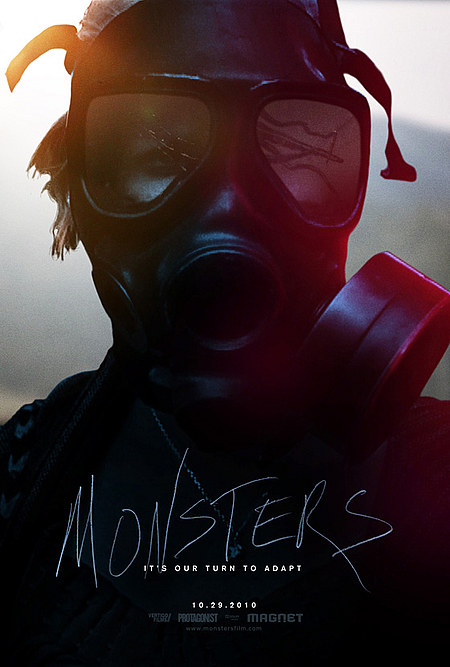
Honorable Mention: Monsters (Click here to read my review)
With Monsters, director Gareth Edwards proves that a big budget is not a necessity when making a monster movie. I read somewhere that Edwards took his two lead actors (Scoot McNairy and Whitney Able) down to Mexico and Texas to shoot the movie guerilla-style. Though the journey seems a bit too long-winded and drawn-out at times, the environments are what blew my mind here. Edwards filmed portions of Monsters in Texas in the wake of Hurricane Ike, and this use of real-world devastation goes a long way toward creating a convincing and believable monster-ravaged world.


10. Let Me In (Click here to read my review)
Cloverfield director Matt Reeves really surprised me with his remake of the 2009 Swedish vampire masterpiece Let the Right One In. Reeves clearly decided to respect both the literary source material and the film that precedes his own; elements of both are present here. Several improvements on the Swedish original exist in this take on the material, primarily the introduction of Elias Koteas's character. I had fairly low expectations for this movie, admittedly because it's a remake, but those expectations were shattered. This is a wonderful English-language adaptation of the Let the Right One In story, with excellent performances by child actors Chloe Grace Moretz and Kodi Smit-McPhee.


9. Unstoppable (Click here to read my review)
This was a shocker for me. Tony Scott's movies are often enjoyable, but his affinity for trippy editing usually brings them down quite a few notches in my book. Not so, however, in the case of Unstoppable. Denzel Washington and Chris Pine star as train conductors who go after a runaway locomotive carrying volatile chemicals across Pennsylvania. I've come to believe, following my viewing of Unstoppable, that every awards season needs a film like this as a lead-in. Unstoppable probably won't win any Oscars, but its leads give great performances and the action is well-paced and a joy to behold.


8. 127 Hours (Click here to read my review)
2010 was the year of the one-man show, as evidenced by acclaimed turns by Ryan Reynolds in Buried and James Franco in this gem, directed by Danny Boyle. The director reunites with several big players from his previous effort, the Oscar-sweeping Slumdog Millionaire, to bring to the screen the harrowing story of Aron Ralston. Ralston was forced to amputate his own arm in 2003 when he became trapped under a boulder while hiking in Moab, Utah. Boyle and company deliver a wonderful movie, but it's Franco's memorable turn as Ralston that sets this one apart.


7. The Town (Click here to read my review)
Ben Affleck is quickly proving himself to be a formidable director on the Hollywood scene. His sophomore effort, an adaptation of Chuck Hogan's novel "The Prince of Thieves", focuses on bank robbers in the Charlestown neighborhood of Boston, from which the film takes its title. Affleck plays Doug MacRay, a thief who becomes involved with the manager of a bank he recently robbed. Jeremy Renner plays MacRay's childhood friend, a hot-headed troublemaker with some destructive tendencies. "Mad Men"'s Jon Hamm plays the FBI agent out to catch them. Rebecca Hall, Blake Lively and the late Pete Postlethwaite also give memorable turns. Though we've seen this story quite a few times before (think Heat meets Point Break), it's the powerhouse cast that sets The Town above much of the other heist flicks out there.


6. True Grit (Click here to read my review)
I knew True Grit would be a great film; I just didn't expect it to be as funny as it is. Jeff Bridges plays the legendary Rooster Cogburn, a drunken U.S. Marshall hired by a young girl to bring her father's killer (a hilarious Josh Brolin) to justice. Newcomer Hailee Steinfeld, just 14 years old, plays that young girl, and she manages to hold her own next to her co-stars. Matt Damon also gives a memorable turn as a Texas Ranger who loves to tell people he's a Texas Ranger. A True Grit remake may not have been entirely necessary, but it did make me wish that all remakes could be directed by Joel and Ethan Coen.


5. Scott Pilgrim vs. the World
Not many people saw Scott Pilgrim vs. the World, and that makes me lose a little bit of faith in humanity. Michael Cera may have worn out his welcome in Hollywood a while ago, but he's excellent as the title character in Edgar Wright's third film. Packed full of hilarious pop culture (especially video game) references and characters who break into fights instead of songs, Scott Pilgrim provided some of the best cinematic moments of 2010. Examples: Brandon Routh as a dumb vegan, a scene-stealing Kieran Culkin, all the "Legend of Zelda" shout-outs, "I'm in lesbians with you", etc.


4. Toy Story 3
Hollywood, this is how you do a threequel. Toy Story 3 takes place years after the second installment in the series, and sees Andy getting ready to head off to college. Through the usual series of mix-ups and misunderstandings, Woody, Buzz and their pals end up at Sunnyside Daycare Center, a seemingly fun place ruled by a pink bear who smells like strawberries. Everything is not as it seems at Sunnyside, as the toys soon learn. In this third outing, Pixar delivers a hilarious, emotional, heartfelt and sometimes heart-wrenching final chapter in the Toy Story trilogy, one that made more than a few people cry in their seats. And as with all of Pixar's cinematic offerings, Toy Story 3 has something to offer for all ages. My personal favorite was the Ken doll, voiced perfectly by Michael Keaton.


3. Harry Potter and the Deathly Hallows: Part 1 (Click here to read my review)
Splitting the final chapter in the Harry Potter series into two films was probably a financial move by Warner Bros., but it has also paid off in spades in the creative department thus far. Part 1 never feels rushed, and the three lead actors give their best performances to date. We spend a lot of time in the woods with Harry, Ron and Hermione, but Deathly Hallows: Part 1 also delivers some of the series' best moments. Though fans could still make an argument for Prisoner of Azkaban, I believe Deathly Hallows: Part 1 is the best Harry Potter film to date.


2. The Social Network (Click here to read my review)
David Fincher's masterpiece The Social Network is a very big reminder of how many components must come together to make a great film. Those components came together better than I could've imagined here. It's rare to see a director, a screenwriter, actors, musicians and more mesh so cohesively. Here, we see the film's creative crew, including Fincher, screenwriter Aaron Sorkin, composers Trent Reznor and Atticus Ross, and a plethora of perfectly-cast actors, join forces to make a film that I would consider robbed if it didn't win the Best Picture Oscar this year. Sorkin's script may take some heavy creative liberties in its telling of the founding of "The Facebook", a fact that's a little disappointing to me. However, the quality of The Social Network makes me not care so much. This is a well-acted, perfectly-scripted and beautifully-directed piece of cinematic genius that, in many ways, defines the age we live in.

I'll be posting this on Facebook, so go figure.


1. Inception (Click here to read my review)
Would you really expect anything else from me? Christopher Nolan's masterful film isn't perfect, but it was easily the best film experience I had in 2010. Nolan somehow managed to combine James Bond with The Matrix, throwing a little dash of 2001: A Space Odyssey into the action for good measure, and ended up with something awesome. The director created a world in which dream-sharing is possible, and then decided to run with it. Like The Matrix before it, Inception manages to deliver an extremely imaginative world and story while simultaneously giving us landmark action sequences. The spinning hallway is easily my favorite action set-piece in film history.

Nolan's approach to the behind-the-scenes aspects of his films is refreshing, to say the least. Watching the Inception's Blu-ray documentaries, you hear the phrase "in-camera" a lot. The guy likes to actually shoot his films, rather than CG them later. Studying these special features further reveals that Nolan actually built a spinning hallway. He actually caused avalanches. And he didn't shoot in 3D. He's a filmmaker who makes movies the way he knows they should be made, and the results are always stunning. To think that his next film is the third Batman movie makes me more excited than I can type.


Well, there's the list. Please, post your favorite movies of the past year below, I'd love to read them.

Film Review: 'True Grit'


Pleasant surprises at the movie theater are always nice. Having seen a few trailers for the Coen Brothers' adaptation of Charles Portis's novel "True Grit", I assumed the film would be a gritty, hard-hitting Western in the vein of No Country for Old Men. While the Coens' take is definitely darker than Henry Hathaway's 1969 version starring John Wayne, it did manage to surprise me in quite a few ways.

Newcomer Hailee Steinfeld plays 14-year-old Mattie Ross, who hires drunken U.S. Marshall Rooster Cogburn (Jeff Bridges) and Texas Ranger LaBoeuf (Matt Damon) to track down Tom Chaney (Josh Brolin), the man who killed her father.

The big story going into the movie seemed to be Bridges taking the proverbial reins from Wayne. Bridges is wonderful as Rooster Cogburn, but that wasn't what stuck out to me when I watched True Grit. It was Steinfeld's performance that made this movie worth watching. Even as a young actress performing in her first film, Steinfeld holds her own alongside Bridges and Damon. She expertly delivers her dialogue, and seems right at home taking on the challenging role of Mattie Ross. Though she may be receiving "Supporting Actress" nominations from a number of outlets, this is most certainly her movie.

That's not to say Bridges and Damon were disappointments here. In fact, the level of comedy they brought to True Grit was very unexpected for me. This is a laugh-out-loud funny movie. Many of the grittier-looking moments in the trailers were actually comedic in nature. Bridges acts appropriately drunken, and Damon brings a hilarious smugness to LaBoeuf, who certainly takes a great deal of pride in his status as a Texas Ranger. Both also manage to inject some much-needed heart into their characters, and it's from there that True Grit gains much of its depth.

I need to mention Brolin, if only for the reaction he drew from the audience with which I watched True Grit. We only saw one shot of him in the main trailers for the film, and his evil-eye glare made me worry that Tom Chaney would be portrayed as a typical, cliché Old West villain. Suffice to say, he isn't. The same goes for Barry Pepper, the leader of Chaney's gang. He does a wonderful job just the same.

Many have argued that a True Grit remake is an unnecessary endeavor. This is a worthy argument, especially considering the fact that John Wayne won an Oscar for his portrayal of Cogburn. I've heard, however, that the Coens stick far closer to the source material. I watched the tail end of the original True Grit today, and the endings are indeed very, very different.

The fact is, we probably didn't need another True Grit, but the novel is acclaimed enough that a more faithful adaptation is tough to deny. The Coens continue to amaze me with their ability to bring their own style to movies based upon the work of others. This is arguably their most mainstream movie, it being a remake and all, but it's still unarguably their own.

Great true Westerns don't come along very often anymore. I'm happy to say, True Grit marks another return to form for the genre. I hate remakes as much as the next film nerd, but I'll see anything the Coen Brothers put to film. This time, they've given us their own take on a classic Western, and have come up gold. True Grit is a funny, well-acted, beautifully filmed entry into the brothers' filmography, and one that shouldn't be missed.

4.5 stars out of 5

Film Review: 'Harry Potter and the Deathly Hallows: Part 1'


The Harry Potter film franchise has always stood in the shadow of the book series on which it is based, and it always will. There exists a certain imaginative charm in the books that simply cannot be captured on film. This is no fault of the filmmakers who have attempted to adapt the various books; it's just a difficulty that comes with the territory.

I initially hated Warner Bros.' decision to split the final installment in the series into two movies; it seemed like a financially-driven decision typical of today's Hollywood's corporate players (see: The Twilight Saga). However, I'm happy to say director David Yates and his team took this decision in stride and subsequently made the best Harry Potter film yet.

Harry Potter and the Deathly Hallows: Part 1 sees Harry (Daniel Radcliffe), Ron (Rupert Grint) and Hermione (Emma Watson) opting to miss their seventh and final year at Hogwarts so they can pursue and destroy the Horcruxes, which hold the key to Voldemort's power.

I noticed something about halfway through this movie: this is the first time the three leads have been tasked with carrying a movie mostly on their own. The aforementioned Hollywood players behind the Harry Potter franchise have an uncanny knack for casting the who's who of British stage and screen royalty in their movies (I think Liam Neeson might be the only one who's missed out thus far). This time, however, we spend most of our time with Radcliffe, Grint and Watson, and we don't even visit Hogwarts. Fittingly, the three give their best performances to date. Their iconic characters feel like real people, and their chemistry reflects the time the actors have spent together on camera all these years.

The performances are definitely helped by the excellent source material. Deathly Hallows is an amazing final installment, make no mistake, and Yates runs with it. From the flying motorcycle chase to the infiltration of the Ministry of Magic to Harry and Hermione's visit to Godric's Hollow (my favorite scene in the entire book series), this movie is packed full of memorable scenes.

The Ministry of Magic scene deserves a special mention. In it, Harry, Ron and Hermione transform into Ministry employees using Polyjuice Potion. The employees, played by David O'Hara, Steffan Rhodri and Sophie Thompson, obviously don't look like the three lead actors, but their performances are hilariously similar. I'd love to ask Yates how he approached this scene; I wouldn't be surprised if some meticulous character workshops were involved. O'Hara, who many will recognize from his roles in The Departed and Wanted, is particularly funny in his interpretation of Radcliffe's walk and physical mannerisms.

That said, we spend a lot of time in the woods in this movie. This was perhaps the biggest complaint fans of the book had upon its release, and it remains here. Yates and crew do their best to switch it up a bit; they change locations and scenery several times, but it still feels like an inordinate amount of time spent wandering the forest.

Aside from that, there isn't much at all to complain about. The leads are wonderful in their roles, as is the supporting cast. The action is filmed perfectly, and the special effects are the best in the series. We've come a long way since Sorcerer's Stone.

It was really disappointing to see Deathly Hallows: Part 1 end. They picked a decent point to leave off, but waiting until July will be excruciating. I still hate the decision to split the seventh installment into two films, but there is a silver lining to that dark cloud: if we can have two movies that are this good instead of just one, then I won't argue. Part 1 receives my highest recommendation. Bring on Part 2.

4.5 stars out of 5

Monday, December 13, 2010

Film Review: '127 Hours'


What to do next?

That must be an interesting question for a director to ask himself, especially following Oscar domination. Danny Boyle’s Slumdog Millionaire nabbed eight statuettes at the 2009 Academy Awards, quite the rare feat. Boyle returns this year with a wildly different movie, but one that is also unmistakably his.

127 Hours follows the well-known story of Aron Ralston, a climber who amputated his own arm in 2006 after it became lodged under a large boulder in Moab, Utah.

If you watched Slumdog Millionaire and 127 Hours without knowing the director’s name, it wouldn’t be difficult to discern that it’s the same guy. The cuts, edits, colors and surreal feel of Slumdog Millionaire all remain intact. Furthermore, Simon Beaufoy and A.R. Rahman return to provide the script and music, respectively, so it’s not exactly a surprise that 127 and Slumdog feel similar.

Unlike Slumdog, 127 is largely a one-man show. James Franco plays Ralston, and his performance is believable to the point of being jaw-dropping. I cannot imagine another actor playing this part. It’s obvious Franco cared a great deal about the role, and this shows in the obvious care he took in filling it. He’s emotional when he needs to be and funny when the time is right, and the desperation on his face and in his dialogue are palpable.

As the director, it was Boyle’s job to help keep us interested in this tale, which takes place mostly in the narrow canyon where Ralston finds himself trapped. Boyle and Beaufoy pull this off by taking us into Ralston’s thoughts and into his past, giving us a glimpse at what went through his mind while fighting for his life. We see moments from Ralston’s childhood, his time with a past love, and even a few glimpses into his future.

In one genius bit, Boyle demonstrates Ralston’s obvious thirst by showing the audience snippets from beverage commercials. It works exactly as it’s supposed to; I wanted to go fill up my Coca-Cola at the concession stand.

In another wonderful scene, Ralston interviews himself talkshow-style through his camcorder. The scene works very well, and also highlights Ralston's biggest mistake that day: not telling anybody where he was going. Scenes like this also serve to highlight the collaborative nature of the movie: Beaufoy's writing is wonderful, and Boyle hits cinematic perfection in the way he switches views as Franco switches roles during his morbidly funny self-interview.

Some of film's more surreal moments might be a little off-putting to some viewers; I know this because I was one of those viewers. The crowd shots that open and close the movie struck me as a little unnecessary and out of place. If they had a point, aside from making us recall Slumdog's greatness, I must've missed it. That said, these are minuscule nitpicks when compared to the greatness displayed by everyone involved in this picture.

One should not review 127 Hours without touching on the amputation scene. After all, we arguably wouldn’t be seeing this movie if Ralston hadn’t been forced to take such an extreme measure to preserve his own life. The scene itself is handled very tastefully and powerfully. This is not a Saw movie; we actually feel for Ralston after following him through his harrowing 127-hour journey.

All the talk of people fainting while watching the amputation is probably accurate; some people can simply take more than others when going to the movies. Boyle frames the surprisingly short scene very tastefully, and judging from the interviews with Ralston that I’ve come across in recent months, the portrayal is actually very true to how the amputation really went down.

All that said, I was focusing on Franco’s face more than his arm during that scene. The look in his eyes does more than the shattered bones and nerve bundle and gore combined. I would nominate Franco for Best Actor on that merit alone, if I had the privilege of voting in the Academy.

127 Hours is a much smaller film than Slumdog, though it still manages to be a cinematic powerhouse at the same time. The music does not stick out as much as it did in Slumdog, and the story is far simpler, as it should be. This is obviously a Danny Boyle movie through and through; his fingerprints are all over it. Beaufoy is at the top of his game as well.

At the end of the day, however, it's Franco who stands out. Boyle was clearly not afraid to let him run with the role. Strip away all the flashy cuts and surreal touches, and you still have an honest, raw and wonderful performance by a very skilled actor. Franco proves here that he can adeptly carry a film, even when he must do so by filling such a difficult role. James Franco is here to stay, and I could not be more excited to see what he does next.

Thursday, December 2, 2010

'Red Dead Redemption: Undead Nightmare' is the best thing ever.


Back in October, I suggested that Rockstar's Red Dead Redemption DLC, Undead Nightmare, just might be the best thing ever.

It is.

My Playstation 3 isn't connected to our Internet, so I can't exactly write a full review since I haven't experienced Undead Nightmare's multiplayer. However, I can write a sweet list explaining the DLC's awesomeness. Here are five reasons why Undead Nightmare could be my game of the year.


1. It puts other downloadable content to shame.
With its Episodes From Liberty City Grand Theft Auto IV add-ons, Rockstar Games demonstrated that its approach to downloadable content would be different from that of other developers. Undead Nightmare continues this trend. This is more than just a typical add-on pack. We get new weapons, new outfits, new challenges, a new visual style, a new main questline, and more. If you're looking to get some bang for your buck, look no further. At about $10 as DLC and $30 on disc (or cheaper if you find a good holiday sale), Undead Nightmare is a steal.

2. The Blunderbuss.
Undead Nightmare introduces several new methods for dispatching foes. Though Holy Water and the Explosive Rifle are very cool, the Blunderbuss steals the show. Its reload time is very slow, and its range is only moderate, but its effect is more than worth dealing with those little caveats. The Blunderbuss essentially turns whatever it's pointed at into a fine pink mist. Oh, and you can create ammo from undead body parts. I love poetic justice.

3. Mythical creatures. Enough said.
I don't want to spoil anything, but suffice to say Undead Nightmare doesn't take itself too seriously. You'll find all kinds of mythical creatures across the game's desolate, zombie-filled landscape. These include the Four Horses of the Apocalypse, all of which can be found, broken and ridden. Each offers a different ability to help John Marston in his quest. Be sure to search for more mythical creatures (and some freaky undead ones) in Undead Nightmare's surreal Wild West.

4. Once again, you get to play after the ending.
Bethesda Softworks and Obsidian Entertainment, take note. Good open-world games let you play after their endings. I love Fallout: New Vegas, but I would've rather seen the game delayed a few months so the ending didn't force me to reload a previous saved game to keep playing. Rockstar devised a very clever way to allow players to continue after Red Dead Redemption's ending, and they don't disappoint here, either.

5. It's a gaming revolution.
My number five may sound like overly high praise, but hear me out. The zombie genre (in every medium) almost always presents apocalyptic scenarios in which the undead have taken over the known world. So, why haven't we seen a truly open-world zombie gaming experience? Resident Evil and Left 4 Dead are great, but they are very linear. Undead Nightmare is the first truly open-world zombie-filled game I've played. I believe zombie games were meant to be played like this, and Rockstar pulled it off in a very big way with this game.


It may be "just DLC", but Undead Nightmare is also the best DLC I've ever experienced. If you like cowboys, zombies or good games in general, you owe it to yourself to give this game a try.